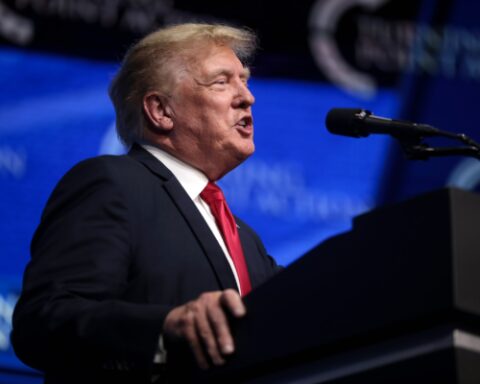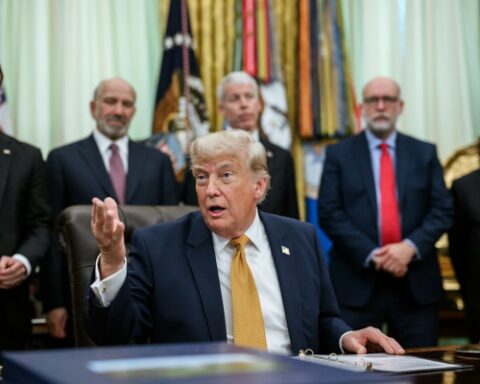

A discussion about President Donald Trump’s economic standing took center stage during a White House press briefing this week, as Fox News correspondent John Roberts pressed administration officials on recent polling that suggests voters remain concerned about the economy ahead of the midterm elections.
Roberts pointed to a new PBS News/NPR/Marist poll showing that 60 percent of Americans disapprove of Trump’s handling of the economy, while just 33 percent approve. The figures reflect a broader trend in recent months, with the president’s economic approval ratings generally remaining in the 30-percent range.
Drawing a historical comparison, Roberts referenced former President George H.W. Bush’s political fortunes in 1992. Despite enjoying exceptionally high approval ratings following the Gulf War, Bush ultimately lost reelection later that year as economic concerns became a dominant issue for voters.
“If you look back to 1992, for example, George H. W. Bush had a 90-something percent approval rating after the Gulf War,” Roberts said. He argued that voters often make up their minds about economic issues well before Election Day and suggested that the administration faces a limited window to improve public perceptions before the midterms.
Roberts further noted that Trump’s 33 percent economic approval rating is lower than former President Joe Biden’s lowest recorded economic approval rating and asked how the president planned to improve those numbers before voters solidify their opinions.
White House Deputy Press Secretary Abigail Jackson rejected the premise that polling accurately reflects Trump’s standing with voters.
“John, you know as well as I do that if the American people trusted these polls, President Trump wouldn’t be in office right now,” Jackson said.
She argued that Trump has repeatedly outperformed polling expectations because he remains focused on issues that resonate with voters. Jackson pointed to the president’s planned visit to Pennsylvania, a state she said played a major role in his election victory.
According to Jackson, voters are focused on priorities such as lowering costs, bringing manufacturing jobs back to the United States, reducing prescription drug expenses, and promoting long-term financial security through initiatives including what she described as Trump Accounts.
Jackson also noted her personal connection to the area the president was visiting, saying she grew up near Pennsylvania’s Lehigh Valley and understood the concerns of local residents.
Roberts acknowledged the region’s economic history but shifted the conversation toward another issue with potential economic implications: the administration’s negotiations with Iran.
The Fox News correspondent suggested that economic confidence could be affected by the success or failure of the developing agreement with Tehran. He pointed to conflicting statements from the United States and Iran regarding nuclear inspections.
Trump has stated that Iran agreed to permit nuclear inspections indefinitely as part of the agreement. Iranian officials, however, have disputed that characterization, saying they have made no new commitments regarding inspections.
Given those conflicting claims, Roberts asked whether the administration would halt negotiations if Iran refused to comply and what consequences that might have for the economy.
Jackson did not directly address the economic implications of that scenario. Instead, she emphasized that the administration’s core objectives have remained consistent throughout the negotiations.
“President Trump’s priorities have not changed throughout this entire conflict,” she said. “And that is that Iran can never have a nuclear weapon, and that the safety and the security of the American people remains paramount.”
The exchange highlighted two issues likely to dominate political debate in the months ahead: voter concerns about the economy and uncertainty surrounding international negotiations. While foreign policy often commands headlines, history has frequently shown that voters ultimately focus on economic conditions at home, even as leaders grapple with tensions and conflicts abroad.