
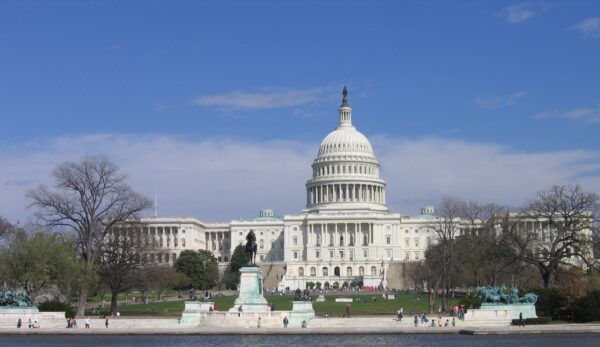
A fresh budget showdown is reportedly brewing on Capitol Hill, with Senate Republicans warning that stalled bipartisan spending negotiations could put the federal government on course for another shutdown just weeks before voters head to the polls in this year’s midterm elections.
The impasse comes after bipartisan negotiations over annual appropriations bills lost momentum this week, prompting Senate Republicans to cancel a scheduled Thursday markup of four spending bills. The delay has fueled concerns that Congress could once again become locked in a high-stakes funding battle with broad consequences for federal agencies and the economy.
Several Republican lawmakers argue that Senate Minority Leader Chuck Schumer (D-N.Y.) is positioning Democrats for another confrontation over government funding, similar to last year’s lengthy battle surrounding enhanced Affordable Care Act health insurance subsidies.
“I think my Democratic friends at the direction of Sen. Schumer are not going to agree to a top-line [spending number] and they’re not going to agree to vote for any appropriations bill, and Sen. Schumer is going to shut down government,” Sen. John Kennedy (R-La.), a member of the Senate Appropriations Committee, said.
Republican concerns intensified after negotiations between Senate Appropriations Committee Chair Susan Collins (R-Maine) and the panel’s top Democrat, Sen. Patty Murray (D-Wash.), reached a standstill.
Collins canceled Thursday’s committee markup after Sen. Mitch McConnell (R-Ky.) was absent because of a health issue, leaving Republicans without enough support to move the legislation forward without Democratic backing.
The breakdown marks a sharp contrast from last year, when the Senate Appropriations Committee advanced many of its annual funding bills with broad bipartisan support. Kennedy pointed to the changing political landscape as one explanation.
“Last year was not an election year,” he noted.
Sen. Shelley Moore Capito (R-W.Va.), chair of the Senate Republican Policy Committee and a senior member of the Appropriations Committee, echoed concerns about Democratic strategy.
“Democrats want to shut us down,” Capito said. “Hopefully we can solve the problem. There’s no support on the other side.”
Democrats, however, argue that any shutdown responsibility would rest with Republicans, who currently control both chambers of Congress and the White House.
Sen. Chris Murphy (D-Conn.) acknowledged another shutdown remains possible but blamed Republican leadership.
“These guys are the Keystone Cops. They don’t know how to run the government, so a shutdown is always possible,” Murphy said.
Democrats also contend Republicans are demanding a significantly larger increase in defense spending than in domestic programs.
“The ratio of four-and-a-half to one, the increase in defense over nondefense. We think that’s way out of line,” said Sen. Dick Durbin (D-Ill.), the second-ranking Democrat on the Appropriations Committee.
Republicans rejected that characterization. A Republican aide described Collins’s proposal as “extremely reasonable” and argued Democrats had responded with an “extremely unreasonable” counteroffer.
The current dispute follows last year’s record-setting 43-day government shutdown, which many Democrats viewed as politically beneficial because it highlighted rising healthcare costs and Republican opposition to extending enhanced Affordable Care Act subsidies.
That experience has prompted some Republicans to prepare an aggressive messaging strategy should another funding lapse occur.
Sen. Rick Scott (R-Fla.) circulated a “Dear Colleague” letter urging Republicans to begin laying the groundwork for a potential shutdown fight this fall.
“Democrats have been clear that they want to shut down government on October 1st because they believe that is their path to a majority in November,” Scott wrote. He urged Senate Majority Leader John Thune (R-S.D.) to support a continuing resolution that would fund the government through the election.
“We need to make it clear to all Americans that Democrats want to shut down government and don’t care how it impacts federal workers or the economy and Republicans want to fund the government,” Scott added.
Scott is also backing legislation sponsored by Sens. Ron Johnson (R-Wis.) and James Lankford (R-Okla.) that would ensure essential federal employees continue receiving pay during a shutdown while providing continuing appropriations to reduce the impact of funding lapses. Lankford’s proposal would also restrict official travel and congressional recesses during a shutdown.
Senate Republicans planned to discuss their strategy with President Trump during a Capitol meeting on Wednesday. Scott said he had already spoken with the president about preparing for a possible funding battle.
Meanwhile, Collins said she would prefer Congress continue advancing individual appropriations bills rather than relying immediately on a continuing resolution, warning that stopgap measures create significant challenges. Still, she acknowledged one may ultimately be necessary to avoid another shutdown.
“I certainly hope not, but we’ll have to see,” Collins said of another shutdown. “So far the negotiations are ongoing … but I would not describe them as going well.”