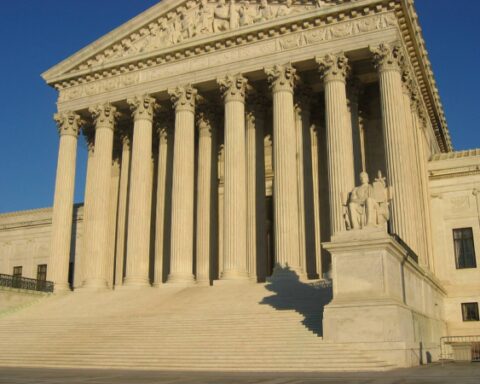

The Supreme Court on Monday handed Alabama officials a significant legal victory, clearing the way for the state to move forward with a previously contested congressional map ahead of the 2026 midterm elections. The decision, which comes amid broader changes to federal voting law, underscores the increasingly complex legal landscape surrounding redistricting—and raises fresh questions about how far courts should go in reshaping electoral boundaries.
In a 6-3 ruling, the high court set aside earlier lower court decisions that had blocked Alabama from using its 2023 House map. That map, drawn by Republican lawmakers, includes one majority-Black district out of seven. The justices also sent the case back to the lower courts for further review, directing them to reconsider their earlier findings in light of the Court’s recent ruling that weakened a key provision of the Voting Rights Act.
The dissenting justices—Sonia Sotomayor, Elena Kagan, and Ketanji Brown Jackson—voiced sharp concerns about the timing and implications of the decision. Writing for the minority, Sotomayor argued that overturning the lower court rulings at this stage would create confusion for voters, particularly as elections loom. She warned that such last-minute changes could disrupt the electoral process rather than clarify it.
At the center of the dispute is the long-running debate over how congressional districts should be drawn and whether race should play a role in ensuring fair representation. Alabama’s 2023 map revived controversy because it included only one majority-Black district, despite earlier court findings suggesting that a second such district may be necessary to comply with federal law.
That earlier finding led to the creation of a court-ordered map used in the 2024 elections, which included two majority-Black districts. Under that arrangement, Alabama’s congressional delegation stood at five Republicans and two Democrats. Now, with the Supreme Court’s latest move, the state may shift back to its original design, pending further legal proceedings.
State officials have defended their approach, arguing that their maps were drawn according to traditional redistricting principles such as minimizing county splits and maintaining geographic coherence. They also emphasized the importance of avoiding what they describe as excessive reliance on racial considerations in mapmaking.
In a filing to the Court, Alabama Solicitor General Barrett Bowdre argued that the lower court’s map was flawed, asserting that there is no requirement for the state to conduct elections under what he characterized as an improperly imposed plan. He framed the issue as one of fairness and constitutional consistency, stating that state officials should have the opportunity to implement districts free from what he called “racial sorting.”
Critics, however, see the matter differently. Democratic Rep. Shomari Figures, who represents one of the state’s majority-Black districts, described the ruling as deeply troubling. In a social media post, he warned that it could undermine Black political representation and likened the potential consequences to earlier eras in American history. Still, he expressed hope that the decision would prove temporary and that lower courts might ultimately preserve the current map.
The legal battle over Alabama’s congressional districts has stretched across much of the decade, with repeated interventions by federal courts and multiple trips to the Supreme Court. The latest ruling does not end the dispute but instead sends it back for further review, ensuring that the fight over representation—and the role of federal oversight—will continue.
As states grapple with redistricting in a shifting legal environment, the broader implications of these decisions remain uncertain. What is clear, however, is that the intersection of law, politics, and representation continues to generate not only legal challenges but also deeper national debates—ones that, in an era of heightened political tension, show little sign of cooling.
[READ MORE: Shifting Winds in the White House: Stephen Miller’s Influence Faces New Reality]