
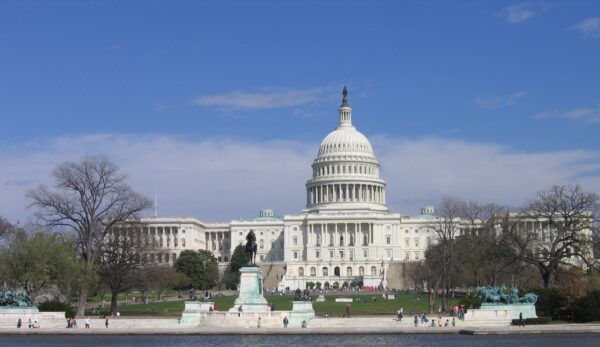
The Senate left Washington, D.C., on Wednesday without tackling several major issues facing Americans before the midterm elections.
The upper chamber is not scheduled to return until after the midterms, leaving high prices and key legislative priorities unresolved. Senators did not address the farm bill, artificial intelligence, mass surveillance or the high cost of living, a top concern for voters.
On Wednesday, Senate Democrats blocked the Ratepayer Protection Act. The bill would have required states to consider making data centers pay for rising electricity costs tied to grid updates.
Because the legislation did not require states to force data centers to pay more, many senators argued it would have no real impact.
Republican Ohio Sen. Jon Husted had hoped passing the bill would help him in his competitive race against former Democratic Ohio Sen. Sherrod Brown.
According to CNBC, electric bills in states with high concentrations of data centers climbed faster than the 6% national average over a one-year period, rising 13% in Virginia, 16% in Illinois and 12% in Ohio.
Affordability remains a top issue heading into the midterms, as energy, electricity and gas prices have surged since the start of the Iran war.
Some Democrats worried about how it would look to vote down a bill aimed at easing rising electricity costs so close to the election. Still, Senate Minority Leader Chuck Schumer called the measure a “fraud” during a Tuesday press gaggle.
Democratic Sens. Amy Klobuchar of Minnesota, Jon Ossoff and Raphael Warnock of Georgia and Maggie Hassan of New Hampshire broke with their party and voted with Republicans to advance the bill.
Republican Maine Sen. Susan Collins, who faces a competitive November race against Democrat Troy Jackson, urged her colleagues in September to pass affordability legislation before leaving town.
Republicans also left without taking up resolutions under the Congressional Review Act targeting California’s energy policies, Punchbowl News reported. That included a House-passed measure that would eliminate the state’s import-export tax on goods moving through its ports. Some of those resolutions will expire before the Senate returns, a win for Democrats.
Senators also did not vote on the farm bill after the 2018 extension expired Tuesday. The lapse creates major uncertainty for farmers, low-income families and rural voters, as funding stops for conservation, rural development, agricultural research and farm loans.
Senate Majority Leader John Thune told reporters Wednesday that the Senate may take up government funding, a third reconciliation package and additional nominations before the end of the year, according to Punchbowl News.
Tech leaders and AI researchers have warned that AI development must slow down, arguing it could destroy the human race within the next decade. Yet the Senate passed no legislation addressing those concerns.
Independent Vermont Sen. Bernie Sanders introduced a bill to ban AI superintelligence, but it never reached the floor. Republican Louisiana Sen. John Kennedy proposed requiring a “kill switch” for all AI models, but Republican Kentucky Sen. Rand Paul blocked it.
Senators also took no action on the $40 trillion national debt.
Before leaving, the Senate confirmed Keith Sonderling as the next Labor secretary.
Meanwhile, Republican political action committees have poured unprecedented sums into red states and districts. Republicans expect to spend between $150 million and $200 million to help Texas Attorney General Ken Paxton, who is neck-and-neck with Democratic Senate nominee James Talarico, according to Punchbowl News.
Republican polling has slipped since the midterm convention. The RealClearPolitics Generic Congressional Vote shows Democrats at 50.6% and Republicans at 42.3%.