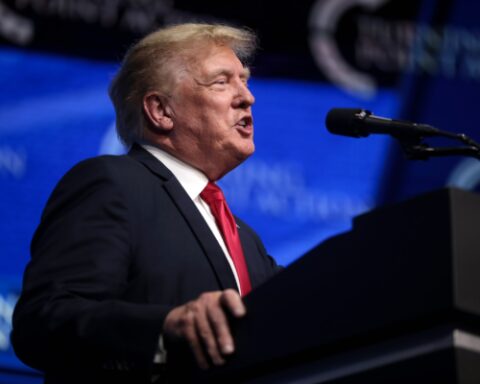


President Donald Trump unleashed on what he called “Fake Polls” Monday morning, accusing “Radical Left Democrats” of using unfavorable polling numbers to discourage Republicans from turning out to vote.
Trump did not identify any specific surveys that prompted his criticism, but took to Truth Social to argue that the numbers being circulated do not reflect what he described as strong support for his administration and the Republican Party.
“The Radical Left Democrats are going CRAZY with Fake Polls,” Trump wrote. “They’re putting them out at levels never seen before.”
The president characterized the surveys as part of what he called “Demoralization Operations,” claiming they are intended to convince Republican voters that their candidates are losing and discourage them from casting ballots.
“They try to demoralize Republicans so that they don’t go out and vote,” Trump wrote.
Trump insisted that what he described as the “actual Polls” were “tremendous” and claimed enthusiasm across the United States remained high.
“The Spirit in our Country has never been higher,” he wrote. “We’re winning against EVERYONE, including Iran, whose Country is in Economic and Military Death Spiral.”
Trump concluded the post by writing, “Thank you for your attention to this matter! President DONALD J. TRUMP.”
While the president did not specify which polls sparked his reaction, several recent surveys and election ratings have painted a potentially difficult picture for Republicans heading into this year’s midterm elections.
The Cook Political Report released ratings on Aug. 20 showing one Democratic-held Senate seat and five Republican-held seats classified as “toss-ups.” Senate polling released by Real Clear Polling during August has also appeared to show Democrats holding an advantage.
Trump’s post also came after revelations involving Median Strategies, a polling company whose surveys were revealed to be fake.
Rahil Prakash, a recent college graduate who established the company’s website, told The Guardian that the project was designed as a “short-term social experiment.”
Prakash said he wanted to determine how fabricated polling information “could enter and spread through the political information ecosystem without independent verification.”
The fake surveys gained more traction than Prakash apparently anticipated, including being used by Karen Bass during her mayoral campaign.
“Did I expect it to perhaps expedite in the way it did? Most definitely not,” Prakash told The Guardian.
He said he did not anticipate California’s political press picking up the polling without prompting.
Prakash ultimately apologized to several political campaigns affected by the bogus numbers.
“I’ll apologize straight out to the campaigns of Karen Bass, Nithya Raman and Francesca Hong for this,” he said.