
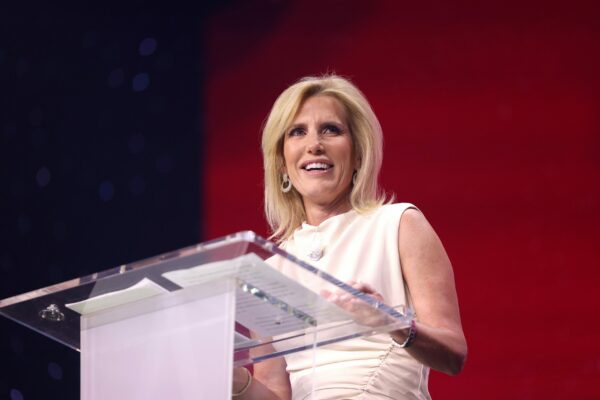
Fox News host Laura Ingraham opened her Monday night program with a pointed line of questioning about President Donald Trump and his handling of the escalating conflict with Iran, suggesting that the stakes may be higher—and the situation more complicated—than initially presented.
Ingraham began by noting that the president had previously set an April 6 deadline for Iran to reach a deal, framing the current moment as pivotal not only for the conflict itself but potentially for Trump’s presidency. With that deadline approaching, she highlighted the uncertainty surrounding both the administration’s strategy and the evolving situation on the ground.
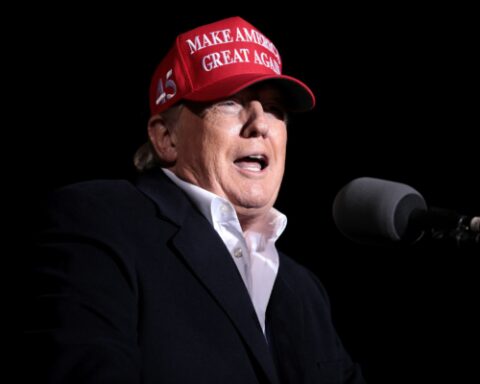
She then aired a clip of Trump describing the state of Iran’s leadership in stark terms, claiming that one regime had been “decimated” and another largely eliminated, while characterizing the current leadership as an entirely different group. Trump suggested this amounted to a form of regime change and described the remaining figures as “very reasonable.”
But Ingraham questioned whether the reality is quite so straightforward. While the president has indicated that Iran is willing to negotiate—telling The New York Post that he is in talks with the country’s parliamentary leader, Mohammad Bagher Ghalibaf—she raised doubts about how much authority that figure actually holds within Iran’s political structure.
Citing reporting from The New York Times, Ingraham noted that Iran’s leadership may be struggling to coordinate following the deaths of key figures. According to those reports, officials are reportedly afraid to meet in person or even communicate openly, fearing surveillance or infiltration. That breakdown in communication, she suggested, could leave negotiators uncertain about what concessions are even on the table—or who has the authority to make them.
This uncertainty, Ingraham argued, complicates any effort to reach a meaningful agreement. If the United States is attempting to negotiate with individuals who may lack both trust and clear authority, the path to a stable resolution becomes far less certain.
At the same time, she pointed to signs that the administration may be preparing for further escalation. Trump has warned of additional strikes, including potential attacks on Iran’s electric infrastructure, oil facilities, and Kharg Island. There are also reports that he is considering deploying ground troops to secure uranium resources—an option that would mark a significant intensification of the conflict.
Ingraham’s tone reflected a broader concern about how quickly the situation could spiral. With limited time and rising tensions, she emphasized that many key questions remain unanswered.
Among them: whether the president was fully briefed on the risks at the outset of the operation, and whether he fully grasped the complexity of what such a conflict could become. She also questioned whether the potential for casualties, collateral damage, and prolonged engagement was clearly understood—or whether the mission was initially framed as a quicker, more contained effort.
The monologue, while grounded in support for strong leadership, underscored a growing unease about the unpredictable nature of military conflict. Even among allies, the challenge now is not just projecting strength, but ensuring that strategy, expectations, and reality remain aligned as events continue to unfold.
[READ MORE: Rubio Pressed on ‘Reasonable’ Iran Contacts as Administration Signals Hope — and Doubt — on Diplomacy]