
An Iranian strike on Prince Sultan Air Base in Saudi Arabia has reportedly left American service members wounded and dealt a serious blow to key U.S. air assets, underscoring the growing risks surrounding the ongoing conflict tied to Operation Epic Fury.
The attack, which occurred in the early hours of March 27 roughly 60 miles south of Riyadh, reportedly involved a coordinated barrage consisting of at least one ballistic missile and multiple attack drones. The precision of the strike was evident in both the damage inflicted and the targets hit, signaling a calculated effort rather than a random assault.
Reports indicate that between 10 and 12 U.S. personnel were injured, with at least two in serious condition. The base has already faced repeated attacks since the start of operations, including an earlier strike that wounded 14 and another on March 1 that killed one American service member.
Beyond the human toll, the damage to equipment could have far-reaching consequences. The strike hit aircraft critical to sustaining U.S. and allied air operations, including KC-135 Stratotanker refueling planes and what is believed to be a severely damaged — and possibly destroyed — E-3 Sentry airborne warning and control aircraft.
Images circulating from the aftermath show a trail of destruction across the installation. Photos appear to capture the charred rear fuselage of an E-3 and its distinctive radar dome destroyed on the tarmac, highlighting the severity of the hit.
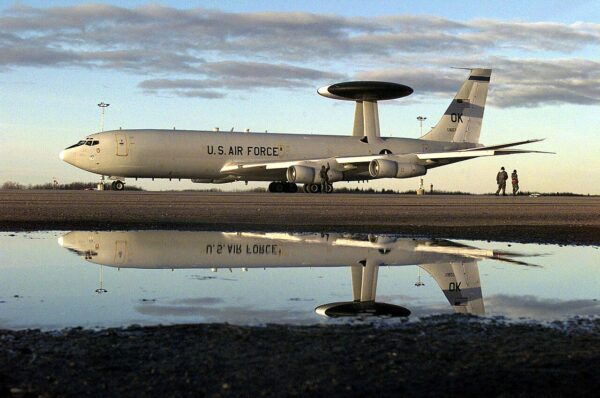
The E-3 Sentry, a modified Boeing 707 equipped with a large rotating radar dome, serves as one of the most important command-and-control platforms in the U.S. military. Its radar can provide 360-degree surveillance over a roughly 250-mile radius, detecting aircraft, drones, and missile launches while coordinating friendly forces in real time.
For decades, the platform has played a central role in major military operations, from Desert Storm to Iraq and Afghanistan, and more recently in campaigns against the Islamic State. Even as the fleet has aged — with the U.S. Air Force reducing its inventory from around 30 aircraft to 16 — the E-3 remains indispensable during complex, high-tempo operations.
Six of these aircraft were deployed to the Middle East ahead of the current conflict, where they have been essential in managing thousands of sorties conducted by U.S. and Israeli forces. Their ability to track threats and direct aircraft effectively makes them the backbone of coordinated air campaigns.
The potential loss of one such aircraft during an active conflict presents more than just a material setback. It weakens the ability to monitor airspace, respond to incoming threats, and coordinate strikes across a rapidly evolving battlefield.
Heather Penney, a former F-16 pilot and analyst, described the loss as “incredibly problematic,” emphasizing the role these aircraft play in everything from airspace management to targeting. She likened their operators to “the chessmaster” guiding the broader fight.
New image reportedly showing the USAF E-3 Sentry destroyed in an Iranian attack at Prince Sultan Airbase on Friday.
Matches 81-0005, an E-3C seen deployed to the base in recent weeks. pic.twitter.com/zRVzzkEPeU
— OSINTtechnical (@Osinttechnical) March 29, 2026
Equally concerning is the apparent precision of the Iranian strike. Rather than simply hitting the base, the attack targeted high-value assets, including refueling tankers and the AWACS platform itself. That level of accuracy suggests access to detailed and timely intelligence regarding aircraft positions and operational patterns.
The base also houses a range of advanced U.S. aircraft, including F-15E, F-35A, and F-16 fighters, making it a critical hub for regional operations.
The strike marks a moment where the broader dynamics of the conflict have come into sharper focus. Iran has demonstrated not only its capacity to strike at range using missiles and drones, but also its ability to target the very systems that enable large-scale U.S. air operations.
As the conflict continues, the incident serves as a reminder that even limited engagements carry significant risks — particularly when critical infrastructure and personnel are exposed. While the mission continues, the costs and consequences of escalation are becoming increasingly difficult to ignore.