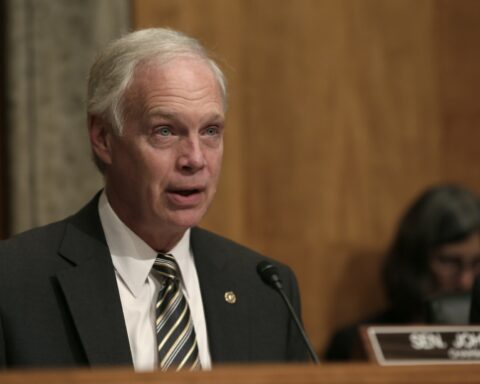

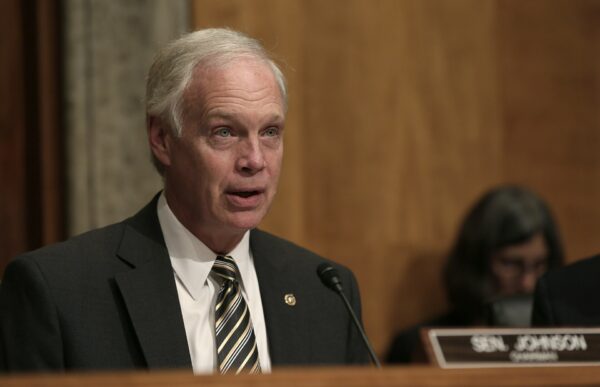
Sen. Ron Johnson (R-Wis.) offered a sharp warning Sunday against what he described as heavy-handed government pressure on news organizations, rebuking comments from Federal Communications Commission (FCC) Chair Brendan Carr suggesting that broadcasters could face losing their licenses over news coverage.
Appearing on Fox News’s “The Sunday Briefing,” Johnson emphasized that the federal government’s role is not to police the press but to safeguard constitutional freedoms.
“I am a big supporter of the First Amendment,” Johnson said. “I do not like the heavy-handed government, no matter who is wielding it.”
The Wisconsin Republican made clear that, in his view, government officials should exercise restraint when it comes to regulating speech, even when disagreements arise over media coverage.
“I would rather the federal government stay out of the private sector as much as possible,” Johnson added. “The federal government’s role is to protect our freedoms — protect our constitutional rights.”
Johnson’s comments came after Carr sparked controversy with a post on the social platform X suggesting that television networks could face consequences if their news coverage fails to meet legal standards required of broadcast license holders.
“Broadcasters that are running hoaxes and news distortions — also known as the fake news — have a chance now to correct course before their license renewals come up,” Carr wrote.
He added a warning about the legal obligations that broadcasters must follow.
“The law is clear. Broadcasters must operate in the public interest, and they will lose their licenses if they do not,” Carr said.
Carr’s post included a screenshot of an earlier message from President Donald Trump on Truth Social criticizing what he called “fake news” and the coverage by legacy media outlets of the ongoing conflict with Iran. The conflict entered its third week on Saturday, and media coverage of the war has become a flashpoint in the political debate surrounding it.
While many conservatives have long argued that large media organizations display bias in their reporting, Johnson’s remarks suggested that government intervention in news coverage raises its own set of concerns.
His stance reflects a broader conservative principle that federal authority should be limited, even when frustration with media institutions runs high. For Johnson, protecting free expression appears to outweigh the desire to punish outlets accused of distorting the news.
Carr’s warning quickly drew fierce reactions from several Democrats, who accused the FCC chair of threatening core democratic principles.
Sen. Elizabeth Warren (D-Mass.) said the remarks were “straight out of the authoritarian playbook.”
California Gov. Gavin Newsom (D) also weighed in, writing on X that the threat was “flagrantly unconstitutional.”
Other Democrats echoed similar concerns. Sen. Mark Kelly (D-Ariz.) described Carr’s comments as an “overreach by the FCC,” while Sen. Chris Murphy (D-Conn.) posted a stark message online.
“A truly extraordinary moment,” Murphy wrote. “We aren’t on the verge of a totalitarian takeover. WE ARE IN THE MIDDLE OF IT. Act like it.”
The controversy unfolded just one day after the White House criticized CNN for a report claiming that the Trump administration underestimated how the war with Iran could affect the Strait of Hormuz. The strategic waterway is one of the world’s most critical maritime choke points, with roughly a fifth of the global oil supply passing through it each day.
CNN leadership defended its reporting following the administration’s criticism.
In a statement, CNN Chair and CEO Mark Thompson said the network “stand[s] by our journalism.”
As tensions continue to rise over media coverage of the war and the broader political response to it, Johnson’s remarks served as a reminder that even in times of conflict and heated rhetoric, debates about government power and constitutional limits remain central to the American political system.
[READ MORE: Tucker Carlson Claims DOJ May Target Him Over Iran Contacts as Debate Over War and Dissent Intensifies]