
A member of San Francisco’s Homelessness Oversight Commission has unintentionally laid bare the fundamental failures of the city’s liberal homelessness strategy, unveiling an interactive website that highlights why massive taxpayer spending has done little to reduce the number of people living on the streets.
Sharky Laguana, an elected commissioner, launched the site to model policy trade-offs in homelessness services. While framed as an educational tool, the simulations underscore a sobering reality: years of progressive policies and soaring budgets have failed to meaningfully reduce homelessness in one of the nation’s most heavily governed liberal cities.
The website opens with a tutorial explaining two interactive models, one focused on permanent supportive housing and the other on public health allocation trade-offs. The simulations rely on data from the San Francisco Department of Homelessness and Supportive Housing. Laguana told the San Francisco Standard that the models are not meant to offer solutions, but instead to illustrate how people flow through the system.
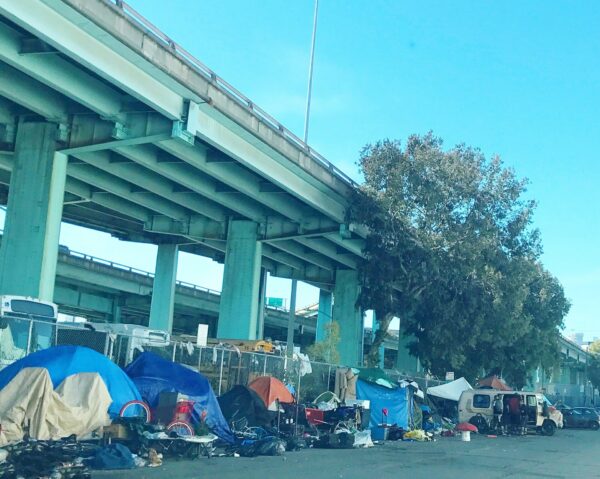
In an introductory video, Laguana acknowledges that San Francisco’s homeless population has hovered around 8,000 people for years, even as homelessness spending has exploded. The city’s inability to move that number downward, despite unprecedented investment, raises uncomfortable questions for progressive leaders who have long argued that more money is the answer.
“Our budget for homelessness has increased significantly during this time, so why are we not seeing reduced homelessness?” Laguana asks. He notes that focusing on the static population number masks the reality that far more individuals cycle through the system — a point that highlights inefficiency rather than success.
The core of the models allows users to manipulate variables such as how many supportive housing units are added each year, how many people enter the system, and how long residents remain housed. According to the Standard, the simulations show that shorter stays and lower inflow reduce occupancy rates and free up housing units. In other words, the city’s current model — characterized by long stays and ever-rising inflow — locks up resources and limits how many people can actually be helped.
The public health allocation model delivers an even harsher verdict on San Francisco’s approach. With a finite budget, the more people the city attempts to serve, the less assistance each individual receives. Laguana openly admits the system is on an unsustainable path.
“Our inflow is increasing faster than our outflow. This is not sustainable over the long run,” he says in the video. He concedes that the city has only kept homelessness numbers from rising further by continually increasing spending — a strategy that depends on endless taxpayer funding and offers no clear endgame.
San Francisco’s struggles are emblematic of broader failures across California’s progressive cities. Data submitted to the U.S. Department of Housing and Urban Development in 2023 estimated 7,582 homeless individuals in the city. In 2024, when sheltered and unsheltered populations were counted in the same year, the total jumped to 8,323, with more than 20,000 people seeking services.
That count was widely criticized as chaotic and unreliable, with then-Mayor London Breed appearing publicly confused about the data. Yet despite questionable metrics, spending surged anyway. The Department of Homelessness and Supportive Housing’s budget reached nearly $850 million in fiscal year 2024–25 before dropping slightly to $786 million the following year.
Laguana told the Standard that preventing homelessness and moving people more efficiently through supportive housing are the two biggest challenges — an implicit acknowledgment that the current liberal model prioritizes maintenance over outcomes.
Renominated in August 2025 by San Francisco Mayor Daniel Lurie, Laguana brings personal experience to the role, having previously experienced homelessness himself. But the data-driven picture his tool presents reinforces a growing criticism: San Francisco’s homelessness system has become a sprawling, expensive bureaucracy that stabilizes failure rather than solving the crisis.
For taxpayers watching hundreds of millions of dollars pour into programs with little to show for it, Laguana’s website offers an unintended conclusion — that liberal governance has mastered spending on homelessness, but not reducing it.