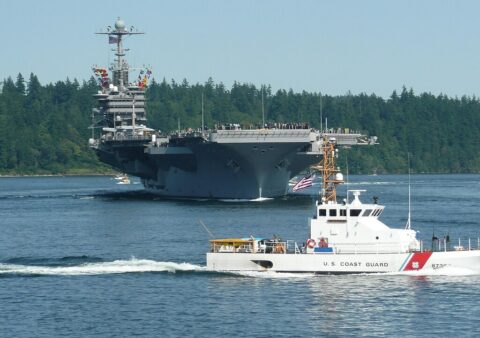

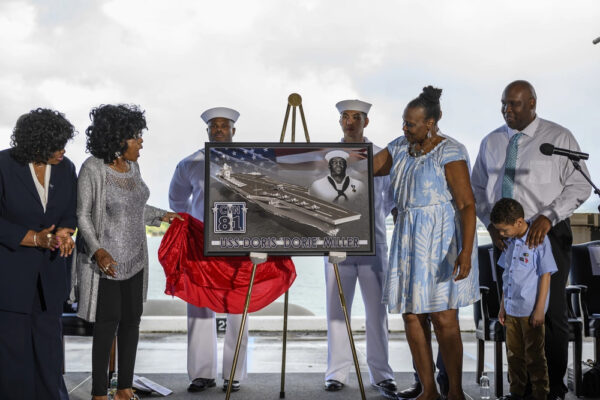
The U.S. Navy says its future aircraft carrier will keep the name of Doris “Dorie” Miller, the Black World War II sailor honored for his heroism during the attack on Pearl Harbor. The confirmation ends months of speculation that the ship could instead be named after President Donald Trump.
“There is no intention to change the name of the USS Doris Miller,” a spokesperson for Acting Navy Secretary Hung Cao said in a statement on Nov. 20.
The Ford-class carrier, designated CVN-81, was named for Miller during Trump’s first term. Then-Acting Navy Secretary Thomas Modly announced the name in January 2020 at a Martin Luther King Jr. Day ceremony at Pearl Harbor. Trump himself praised the decision at the time.
The ship will be the first U.S. aircraft carrier named for a Black American and the first named for an enlisted sailor.
In August, reports that Navy leaders were discussing renaming the carrier after Trump sparked backlash, especially from Miller’s family. Thomas Bledsoe, Miller’s great-nephew, told CNN the possibility “was quite a shock.” At the time, the Navy said it had “no announcement to share.”
The decision has drawn praise from both parties. Republican Rep. Nancy Mace called it the “right call.” Democratic Reps. Wesley Bell, Marilyn Strickland and Kweisi Mfume had urged Defense Secretary Pete Hegseth to keep Miller’s name on the ship.
Newport News Shipbuilding, part of HII, has scheduled a ceremonial keel laying for the Doris Miller on Dec. 5 in Newport News, Virginia. The carrier was originally slated for 2032, but delivery has been pushed back to February 2034 because of constraints at the shipyard.
Miller was born in rural Texas to sharecroppers. He joined the Navy in September 1939 after struggling to find work in the Jim Crow South. At the time, Black sailors were largely limited to the messman branch and barred from training in specialties such as gunnery.
On Dec. 7, 1941, Miller was serving aboard the battleship USS West Virginia and was doing laundry when the first Japanese torpedo struck. He helped carry the ship’s mortally wounded commanding officer, Capt. Mervyn Bennion, to a sheltered spot.
Miller then took over an unattended .50-caliber machine gun, despite having no training on the weapon, and fired at Japanese aircraft.
“It wasn’t hard,” he later recalled. “I just pulled the trigger and she worked fine.”
He stayed at the gun until it ran out of ammunition and the order came to abandon ship. He also helped pull fellow sailors through oil and water to safety, likely saving several lives. He was among the last three men to leave the West Virginia, where 106 crewmembers died that day.
Miller became the first Black sailor awarded the Navy Cross. He was killed in November 1943 when a Japanese submarine torpedoed the escort carrier USS Liscome Bay during the Battle of Makin.
Calls to upgrade his Navy Cross to the Medal of Honor have continued for decades. The Navy has reportedly recommended him for the honor, but final approval rests with Congress and the president.