

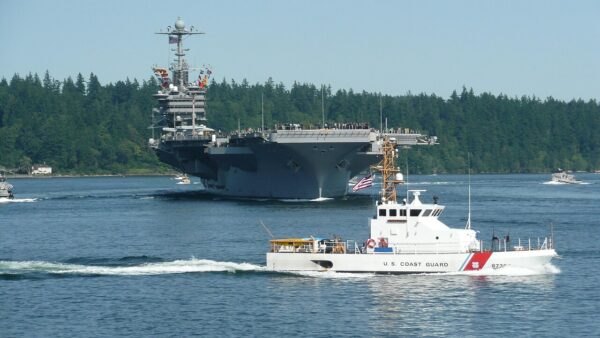
The U.S. Navy is considering a significant redesign of its newest aircraft carriers as it works to implement changes sought by President Donald Trump, including potentially relocating the ships’ command tower to more closely resemble older warships.
An internal Navy review is examining whether to move the multistory command center, known as the “island,” toward the middle of future Ford-class carriers, a former senior U.S. official familiar with the deliberations told The Hill.
The review was launched in part because of Trump’s concerns about the appearance of Ford-class carriers and is expected to be completed within “several” weeks, according to the official.
A Navy official said Trump ordered the service to “implement design changes to our future aircraft carriers” and that the Navy “has begun moving out on options to meet the President’s intent.”
The island, typically located on the starboard side of an aircraft carrier, serves as the nerve center for flight-deck operations, tactical command and navigation.
Hunter Stires, who served as maritime strategist to the Navy secretary until last year, criticized the potential change, arguing that warships should be designed for combat effectiveness rather than appearance.
“The placement of the island on the Ford class was chosen to support the ship’s design purpose of maximizing aircraft sortie generation — which for an aircraft carrier, directly translates to combat power,” Stires said.
Stires argued that spending taxpayer money and engineering resources to redesign the carriers based on aesthetics would be “wasteful and abusive.”
Rear Adm. Paul Lanzilotta, the former captain of the USS Gerald R. Ford, explained in 2022 that placing the island farther back creates additional space for aircraft preparing for takeoff.
Lanzilotta said the arrangement allows aircraft experiencing minor problems to troubleshoot and then taxi toward the catapult without waiting for a break in other flight-deck operations.
Moving the island would mark another major carrier design change influenced by Trump.
On Thursday, Trump directed the Navy to abandon electromagnetic catapult systems on future aircraft carriers and return to steam-powered systems. Officials and experts have said that change could cost billions of dollars and reduce operational efficiency.
Trump’s national security memo directed the Navy to ensure Ford-class carriers, including the USS Doris Miller currently under construction, use steam-powered catapults and hydraulic systems instead of the newer Electromagnetic Aircraft Launch System and Advanced Weapons Elevators.
The Navy currently has three Ford-class aircraft carriers under construction, including the USS Doris Miller and the nuclear-powered USS Enterprise, which Huntington Ingalls Industries is building at Newport News Shipbuilding.
The service also operates 11 Nimitz-class aircraft carriers.
The potential redesign comes with significant financial stakes. According to an August estimate from the nonpartisan Congressional Budget Office, construction of Ford-class aircraft carriers is expected to cost approximately $22 billion per ship.