
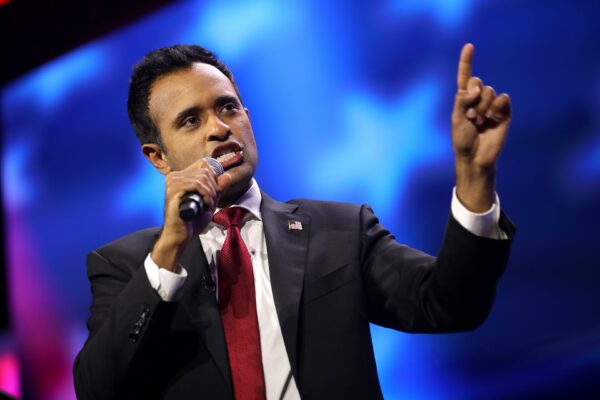
Republican gubernatorial candidate Vivek Ramaswamy took center stage Tuesday night at a Turning Point USA event held on the campus of Ohio State University, where he tackled a wide range of questions from students on issues spanning immigration, foreign policy, and his alignment with the broader conservative movement.
The event, moderated by Lawrence Jones, offered Ramaswamy an opportunity to defend positions that at times diverge from the traditional MAGA base. Among them was his continued support for H1-B visas, a stance that has drawn criticism from some conservatives who favor stricter immigration limits. Ramaswamy has argued that such visas serve a role in bringing high-skilled labor into the United States, a position he reiterated during the discussion.
But the most pointed exchange of the evening came when a student pressed him on U.S. financial aid to Israel. Referencing estimates that the United States has spent billions in support, the student questioned whether those funds could be better used domestically, citing potential benefits such as healthcare, groceries, and housing assistance for Americans.
Ramaswamy responded by drawing a distinction between two issues he said are often conflated: the broader question of foreign aid and what he described as a more narrow focus on Israel specifically. He noted that during his presidential campaign, he was the only Republican candidate on the debate stage to openly call for phasing out the roughly $3.8 billion in annual aid to Israel over time. That position, he said, drew criticism from multiple sides and may have come at a political cost.
At the same time, Ramaswamy cautioned against what he characterized as a disproportionate fixation on that specific line item in the federal budget. He argued that far larger sums are lost to what he described as waste, fraud, and abuse across a wide range of government programs, including foreign aid to numerous other countries. In his view, singling out Israel without addressing those broader issues risks missing the bigger picture.
He also raised concerns about the motivations behind the intense focus on Israel, suggesting that in some cases it may reflect underlying biases. While maintaining that he believes the long-term phaseout of aid could serve U.S. interests—and even Israel’s—he emphasized that the conversation should not ignore the larger scope of federal spending.
The student who posed the question clarified that her inquiry was based on Ramaswamy’s own previously stated position, and the candidate acknowledged that her framing was fair. Still, when pressed directly on whether he would lobby Congress to halt funding, Ramaswamy declined to commit.
Instead, he pivoted back to his central campaign message, stressing that his primary focus is on governing at the state level. He outlined priorities such as lowering costs, increasing wages, and improving education in Ohio, arguing that foreign policy decisions ultimately fall outside the scope of a governor’s responsibilities.
The exchange highlighted the tension within conservative circles over foreign policy and spending priorities, as well as the broader challenge of balancing domestic concerns with international commitments. While debates over aid and alliances continue, moments like this suggest that even within one political movement, there is ongoing disagreement about how best to define “America First” in practice—and whether the costs of global engagement are always justified.
[READ MORE: Vance’s Pakistan Trip Delayed as Iran Peace Talks Remain Uncertain]