
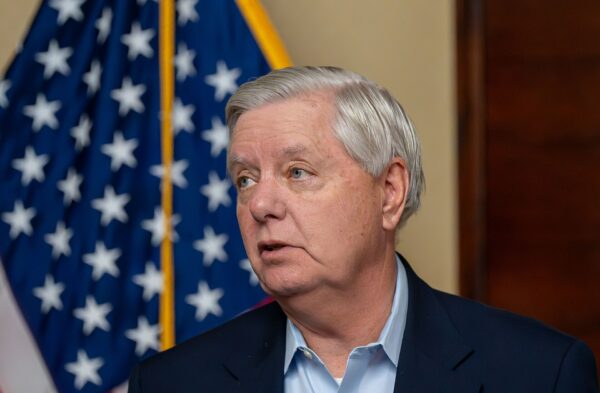
Senator Lindsey Graham, R-S.C., forcefully pushed back Sunday against repeated questions from NBC’s Kristen Welker over whether President Donald Trump has a “plan” for Iran following the death of Supreme Leader Ali Khamenei in Saturday’s attack.
The exchange, which aired on NBC’s Meet the Press, quickly turned tense as Welker opened by asking, “Is the United States at war with Iran?”
Graham responded by framing the moment as a major turning point in the fight against terrorism.
“I think the Ayatollah would say yeah,” Graham said. “I don’t know if this is technically a war, but here’s what I can say the headline is for me Sunday. The mother ship of terrorism is sinking, the captain is dead. The largest state sponsor of terrorism, Iran, is close to collapsing.”
Welker then shifted to the question of leadership in Tehran, asking who would be responsible for replacing Khamenei.
“Will the United States pick the next leader of Iran, or will the Iranian people pick the next leader?” she asked.
“No,” Graham replied, rejecting the premise that Washington would attempt to install a new regime. “There will be no American boots on the ground. This is not Iraq, this is not Germany, this is not Japan. We’re going to free the people up from the terrorist regime.”
Graham said the objective is not to occupy Iran or dictate its future political structure, but to ensure that whoever leads the country can no longer use it as a base for global terrorism.
“And the goal is not only to help the Iranian people to chart a new destiny,” he said, “to make sure no matter who takes over in Iran, no matter who it is, no matter who the people pick, they cannot become the largest state sponsor of terrorism. They can’t fuel Hezbollah, the Houthis, and Hamas. They can’t have ballistic missiles, they can’t have a nuclear weapon. They will be out of the terrorism business. So the people will pick.”
Welker pressed the issue, pointing to the complexities of past regime changes.
“Senator, history tells us just how complicated regime change is,” she said, referencing the ouster of Saddam Hussein and the instability that followed. “How will the United States make sure that the next Iranian government isn’t worse than the current regime?”
“That’s not our job, to pick the next Iranian government,” Graham shot back. He contrasted the situation with Iraq, noting the U.S. relationship with that country today. “It’s up to Iran to pick your leader. It’s not my job, it’s not President Trump’s job. We’re not going to occupy the country. We’re going to give the people of Iran a chance to do something they’ve never had before: chart their own destiny.”
Welker also cited a Truth Social post from President Trump expressing hope that Iran’s Islamic Revolutionary Guard Corps and police would peacefully merge with Iranian patriots to restore the country.
“Is hope the plan for the future of Iran?” she asked.
“No,” Graham responded. “The future of Iran is going to be determined by the Iranian people. The new Iran, whatever it is, whether it’s a cleric, or a representative democracy, our goal is to make sure it cannot become again the largest state sponsor of terrorism. That’s a win for us. That’s a win for the region.”
When Welker continued to demand whether there was a concrete plan to guarantee that outcome, Graham grew visibly frustrated.
“No, it’s not his job or my job to do this!” he said. “How many times do I have to tell you?! Our job is to make sure Iran is no longer the largest state sponsor of terrorism, to help the people reconstruct a new government, no boots on the ground. You know this idea, ‘you break it, you own it?’ I don’t buy that one bit.”
The exchange highlighted the administration’s stated focus: ending Iran’s role as a state sponsor of terrorism without committing U.S. forces to another prolonged occupation.