

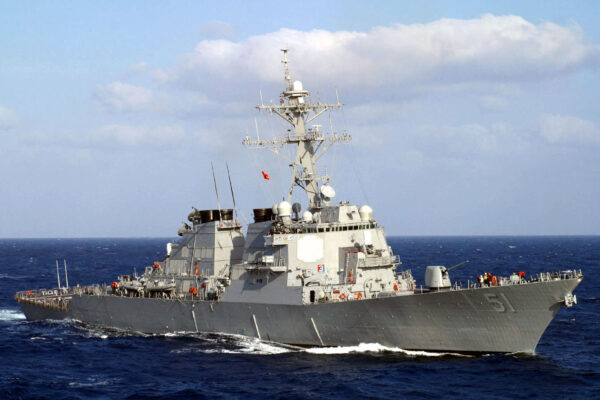
As American and Iranian officials met for high-stakes negotiations aimed at extending a fragile cease-fire, the United States took a visible step to attempt to assert its presence in one of the world’s most critical waterways.
According to multiple U.S. officials, two Navy destroyers entered the Strait of Hormuz on Saturday, where they destroyed an Iranian surveillance drone that approached one of the ships. The move came as part of a broader effort to demonstrate that the strait remains open for commercial traffic, even as tensions linger beneath the surface.
The ships—identified by U.S. Central Command as the U.S.S. Frank E. Petersen Jr. and the U.S.S. Michael Murphy—traveled from the Gulf of Oman into the strait before briefly entering the Persian Gulf and then turning back. Officials said the mission was designed to support eventual mine-clearing operations and to reassure global shipping interests that safe passage is still possible.
During the operation, an Iranian surveillance drone was intercepted and destroyed. U.S. officials emphasized that the drone did not pose a direct threat, but said the Navy acted to prevent Iranian forces from tracking the ships’ movements. They also stressed that the action did not violate the terms of the current cease-fire.
Still, the incident underscores just how delicate the situation remains. While both sides have agreed to a temporary halt in hostilities, the presence of military assets in such close proximity carries inherent risks. Even limited engagements, like the destruction of a drone, have the potential to escalate if misinterpreted.
Iran, for its part, denied that U.S. warships entered the strait at all. A military spokesman, Ebrahim Zolfaghari, said Iranian forces remain in control of the waterway, according to state media. Separately, the semiofficial Tasnim News Agency claimed there was no active shipping traffic in the strait and asserted that Iran had refused permission for an American vessel to enter.
The conflicting accounts highlight the uncertainty surrounding conditions in the strait, which serves as a vital artery for global energy shipments. Under the terms of a two-week cease-fire announced earlier in the week, Iran agreed to reopen the passage to commercial vessels. However, U.S. officials say progress has been slow, citing difficulties in locating and removing naval mines that Tehran allegedly deployed.
Officials also suggested that Iran may be reluctant to fully reopen the strait, with concerns that it could attempt to impose tolls on passing ships. The exact number of mines in the waterway—and the level of danger they pose—remains unclear.
For now, the U.S. military appears to be walking a careful line. While it seeks to demonstrate freedom of navigation and protect international commerce, it is also attempting to avoid triggering a broader confrontation at a time when diplomatic talks are ongoing. Those negotiations, taking place in Islamabad and led by Vice President JD Vance, are seen as a critical opportunity to stabilize the situation.
U.S. Central Command indicated that additional resources, including underwater drones, will be deployed in the coming days to assist with mine-clearing efforts.
As both sides test the boundaries of the cease-fire, the episode serves as a reminder that even in moments labeled as “peace,” the shadow of conflict is never far away.