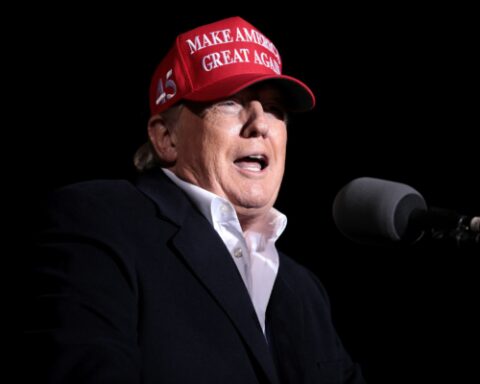

President Donald Trump signaled support Thursday for the possibility of Iranian Kurdish forces launching a ground incursion into Iran, calling the idea “wonderful” in remarks during a phone interview with Reuters.
“I think it’s wonderful that they want to do that, I’d be all for it,” Trump told the outlet when asked about reports that Kurdish fighters could potentially move against the Iranian regime.
Trump stopped short of confirming whether the United States would provide direct military assistance for such an effort. When asked specifically whether the U.S. might offer air cover to Kurdish forces operating inside Iran, the president declined to provide details.
“I can’t tell you that,” he said, though he emphasized that the goal for the Kurds would be clear: “to win.”
“If they’re going to do that, that’s good,” Trump added.
The possibility of Kurdish fighters becoming involved on the ground in Iran has generated increasing discussion among analysts and commentators as tensions surrounding the region continue to evolve.
During a segment on MSNBC’s “MS NOW,” host Ana Cabrera raised the issue with senior national security reporter David Rohde, who discussed reporting surrounding a potential effort involving Kurdish groups.
“David, you’ve been reporting on the possibility of the U.S. arming Iranian Kurds on the ground. What are you learning?” Cabrera asked.
Rohde explained that the groups being discussed are believed to be Iranian Kurds who reside just outside Iran’s borders in northern Iraq. According to reporting he referenced, there have been indications of a possible CIA effort to arm those fighters and potentially send them across the border.
“What we’re talking about is possibly these are Iranian Kurds who live just outside of Iran in northern Iraq, and there’s been reporting that there was a CIA effort to begin arming them and possibly sending them over the border into Iraq,” Rohde said.
However, the White House has pushed back on claims that any such operation has been formally authorized. White House spokesperson Karoline Leavitt said the president has not given any order for Kurdish forces to enter Iraq.
Rohde noted that the concept remains only a potential option under discussion rather than an active operation.
“I think this is a card that the U.S. could possibly play,” he said, adding that available reporting suggests any weapons involved would likely be limited to small arms.
The strategic goal of such a move, according to Rohde, could be to create pressure on Iran’s military by forcing it to redirect forces internally.
Still, he cautioned that Kurdish forces alone would not have the capacity to bring down Iran’s government.
A senior U.S. intelligence official told Rohde that Iranian Kurds represent only about 10 to 15 percent of Iran’s total population, making it unlikely they could overthrow the regime on their own.
“They cannot single-handedly topple the government in Iran,” Rohde explained. “They’re just not big enough. They would need many other groups to join them.”
Retired Army Colonel Jack Jacobs also weighed in on the potential risks of arming Kurdish fighters during the discussion.
Jacobs argued that such a strategy would pose relatively little direct risk to the United States, noting that the weapons reportedly under consideration would consist mainly of small arms and automatic tactical weapons.
However, he warned that even if Kurdish fighters launched a ground assault, the ultimate outcome in Iran would depend largely on the role of the country’s military.
Jacobs pointed specifically to Iran’s army and the Republican Guard as central players in any potential change within the country.
“The lynchpin in whatever happens in Iran” remains the Iranian military, Jacobs said.
He added that Iran’s ruling theocracy continues to survive largely because of the army’s support, and that any effort to bring down the government would require the cooperation of the Iranian military itself.
“At the end,” Jacobs concluded, “the theocracy is in business, at least partially, if not almost wholly, because of the support of the army.”
[READ MORE: Newsom Criticizes Israel at Book Event, Suggests U.S. May Need to Rethink Military Support]