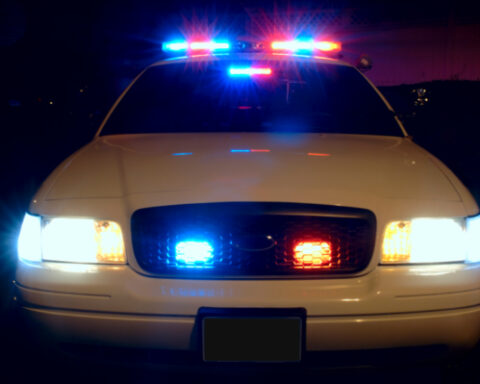

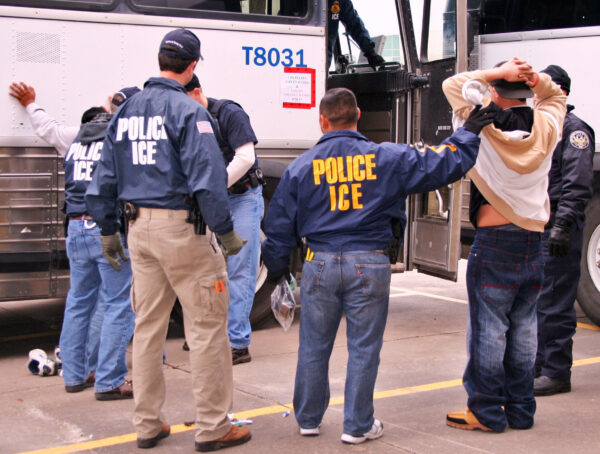
United States Immigration and Customs Enforcement agents are detaining and arresting individuals who identify themselves as “legal observers” after they allegedly used their vehicles to follow federal agents during immigration enforcement operations.
According to Reuters, ICE has detained and arrested thousands of Minnesota protesters under Title 18, Section 111 of the U.S. Code. The federal statute makes it a crime to interfere with a federal officer performing official duties. The enforcement surge follows a recent trend in which protesters began trailing ICE agents in their cars, claiming they were acting as “legal observers” in response to the deadly shootings of Renee Good and Alex Pretti in Minneapolis in January.
Department of Homeland Security spokesperson Tricia McLaughlin told Reuters that individuals who insert themselves into active law enforcement operations risk serious consequences.
“When agitators willingly involve themselves and inject themselves in law enforcement operations, they are risking arrest as well as jeopardizing the safety of themselves and those around them,” McLaughlin said.
A Reuters review of federal court records found that the Trump administration has charged at least 655 people under Title 18 during the relevant period, roughly double the number charged during the same timeframe between 2024 and 2025.
The statute in question carries significant penalties. It prohibits anyone from forcibly assaulting, resisting, opposing, impeding, intimidating, or interfering with federal officials engaged in the performance of official duties. Violations can result in up to eight years in prison, or up to 20 years if the offense involves the use of a deadly weapon or results in bodily injury.
The legal battle over how far protesters can go while observing law enforcement remains ongoing. In January, U.S. District Judge Kate Menendez of Minnesota issued an injunction preventing federal agents from stopping vehicles that were following them, provided those vehicles maintained what she described as a “safe” and “appropriate” distance, according to Politico.
However, the Department of Homeland Security appealed the ruling, and the 8th U.S. Circuit Court of Appeals blocked the injunction just 10 days after it was issued, Reuters reported. The appellate court will now decide whether to issue a long-term stay or restore the lower court’s order.
Reuters noted that Judge Menendez’s original injunction did not define what constitutes a “safe” or “appropriate” following distance, leaving uncertainty about how the standard should be applied in practice.
Many protesters have defended their actions by citing First Amendment rights. They argue that they are legally entitled to observe and record law enforcement activity in public spaces. Legal experts, however, have stated that while citizens generally have the right to observe and document public police activity, that right does not extend to intentionally obstructing officers or interfering with their duties.
The broader debate over protest activity and federal law enforcement has intensified following the arrest of former CNN host Don Lemon and other anti-ICE demonstrators who stormed a church service to protest the death of Renee Good. Lemon has argued that his actions were protected under the First Amendment as an “act of journalism.”
Assistant Attorney General Harmeet Dhillon, however, stated that Lemon’s conduct violated federal laws that prohibit obstructing houses of worship and engaging in conspiracies against a person’s civil rights.
As courts weigh the limits of protest activity and federal authority, ICE continues to enforce Title 18 against individuals it says are interfering with lawful immigration operations.
[READ MORE: GOP Rule Vote Wobbles as Lawmakers Clash Over Trump Tariff Protections]