
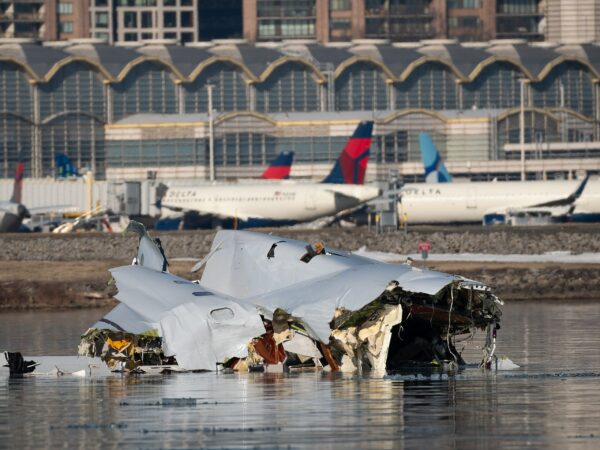
The National Transportation Safety Board on Tuesday laid out the findings of its investigation into the deadly 2025 mid-air collision between an American Airlines passenger jet and a U.S. Army helicopter, concluding the tragedy that killed 67 people was entirely preventable.
The hearing came nearly one year after the Jan. 29, 2025, crash over Washington, D.C. NTSB Chair Jennifer Homendy said flatly after the session that the collision should never have happened.
“This was 100% preventable,” Homendy said, pointing to a cascade of failures across multiple institutions, with the Federal Aviation Administration drawing particular criticism.
Investigators said the FAA ignored repeated warnings about dangerously congested airspace around Reagan National Airport. According to Homendy, air traffic controllers at the airport’s tower repeatedly raised concerns that were dismissed by higher-level FAA management.
“We have an entire tower who took it upon themselves to try to raise concerns over and over and over again only to get squashed by management and everybody above them within FAA,” Homendy said during the hearing.
NTSB officials said the crash exposed systemic problems, including an overreliance on pilots to visually separate aircraft in one of the most crowded and complex airspaces in the country. Visual separation requires pilots to maintain safe distances without automated warnings, a practice investigators said was inappropriate given the conditions.
During the hearing, NTSB members presented the most detailed reconstruction of the crash to date. The presentation showed the Army helicopter colliding with the American Airlines jet, with the helicopter’s rotor blade slicing through one of the plane’s wings. Both aircraft immediately plunged into the Potomac River.
Reporting from The Washington Post highlighted numerous contributing factors. Investigators said aircraft instruments provided inaccurate readings, collision avoidance technology was lacking on both the helicopter and the commercial jet, and the surrounding airspace was overcrowded. FAA maps also failed to clearly define the helicopter’s precise route, and the plane’s crew was never warned by air traffic controllers that a helicopter was nearby.
Investigators believe the helicopter crew likely mistook the American Airlines aircraft for a different plane farther away and also thought it was flying at a lower altitude than it actually was. NTSB officials said the crash could have been avoided had the crew known their instruments might display inaccurate altitude information.
Homendy expressed visible frustration over how close the two flight paths were and questioned how the danger went unnoticed.
“How is it that no one, absolutely no one in the FAA did the work to figure out there was only 75 feet, at best, 75 feet of vertical separation between a helicopter on Route 4 and an airplane landing on runway 33?” she asked.
The investigation also revealed staffing concerns. At the time of the crash, a single controller at Reagan National was managing five helicopters and six airplanes after working alone for more than five hours. Tower recordings captured collision alert warnings sounding nine times in the 18 minutes before the crash, according to The Washington Post.
Despite the failures, investigators said there is no evidence that any pilots or controllers involved were impaired, unqualified, or sleep-deprived. However, the FAA failed to conduct timely drug and alcohol testing of the controllers after the crash, another lapse highlighted during the hearing.
In response to the tragedy, the FAA has since banned non-essential helicopter traffic near Reagan National Airport and permanently closed the route used by the Army Black Hawk helicopter that night. The helicopter carried three crew members. The American Airlines jet was carrying 60 passengers, including youth figure skaters and coaches.
Among the victims were the parents of U.S. figure skater Maxim Naumov. He plans to compete in next month’s Winter Olympics in their honor, a reminder of the human cost behind what investigators say was a wholly avoidable disaster.